
Winter gives you something the rest of the year hides: the bare bones of the garden. With the leaves gone, the crossing branch, the dead stub and the shrub that has quietly become a thicket are all suddenly obvious. It is also the season when the most avoidable pruning mistakes happen, usually because someone reached for the secateurs in January at a shrub that was about to flower.
Get the timing right and winter pruning is quick, satisfying work. Get it wrong and you lose a year of flowers.
Which wood is it flowering on?
Nearly every winter pruning decision comes back to this question. Shrubs that flower on new wood — growth made in the coming spring — can be cut back hard now, because there are no flower buds on the stems to lose. Shrubs that flower on old wood, made the previous year, already have their buds sitting there waiting. Cut those in winter and you cut off the display.
A useful shortcut for most gardens: if a shrub flowers before midsummer, prune it straight after flowering. If it flowers from midsummer onwards, prune it in late winter or early spring.
Shrubs to cut back in winter
These take a hard cut well and often look better for it. Late winter is the sweet spot — roughly February into early March in most of the UK, once the worst of the frost has passed but before growth starts in earnest.
- Buddleja davidii (butterfly bush): cut back to a low framework, around 60–90cm from the ground, leaving a permanent set of stems. The flowers come on the new shoots.
- Cornus alba and Cornus sanguinea (dogwoods grown for winter stems): remove a quarter to a third of the oldest stems at the base each year, or coppice every second or third winter, to keep the colour on young growth.
- Salix (willows grown for coloured stems): the same treatment as dogwoods.
- Cotinus coggygria (smoke bush): cut hard if you want big leaves and a compact plant; leave it be if the smoky plumes matter more, as those form on older wood.
- Hardy fuchsia: wait until new shoots appear at the base, then cut back to a low framework. Leaving some top growth over winter shelters the crown.
- Hydrangea paniculata and Hydrangea arborescens: cut back to a permanent framework now. Cutting H. arborescens to around 30cm gives bigger heads on sturdier stems.
- Perovskia and Caryopteris: these subshrubs die back to a woody base. Cut to a low framework of 15–30cm in early spring, once new growth is visible.
The three Ds — dead, diseased and damaged wood — can be removed at any time of year, on any shrub. If a branch is rubbing, broken or clearly dead, it goes.
Shrubs to leave until after flowering
This is the group that catches people out. Forsythia, philadelphus, weigela, deutzia, lilac, flowering currant (Ribes sanguineum), kerria, exochorda and spring-flowering ceanothus all carry their buds through winter. Prune them in the weeks after they flower, taking out the oldest stems at the base and shortening the rest. If you only remember one thing from this guide, make it this: cutting forsythia in January removes exactly the yellow you were waiting for.
The mophead and lacecap hydrangeas (Hydrangea macrophylla and H. serrata) are a special case. They flower on old wood, so hard winter pruning costs you flowers. In spring, simply cut each old flower head back to the first pair of strong buds below it, and take out any weak or crossing stems.
Evergreens, conifers and the awkward ones
Most conifers will not regrow from bare wood, so stay within the green growth and accept that the plant will keep the shape you give it. Yew is the exception and will shoot again from old wood. Leyland cypress, Lawson cypress and most hedging conifers will not.
With evergreens generally, avoid cutting in freezing weather. The plant is not growing, the cut surfaces sit exposed, and frosted wood can shatter rather than cut cleanly. Trim box in late spring to midsummer rather than in the cold, and give lavender and rosemary only a light tidy — cutting into the old, leafless wood usually leaves a permanent gap.
Prunus species, including ornamental cherries and plums, are best left alone in winter. Prune them in late spring or summer instead, when the sap is moving and wounds heal quickly. This reduces the risk of silver leaf and bacterial canker.
Tools and technique
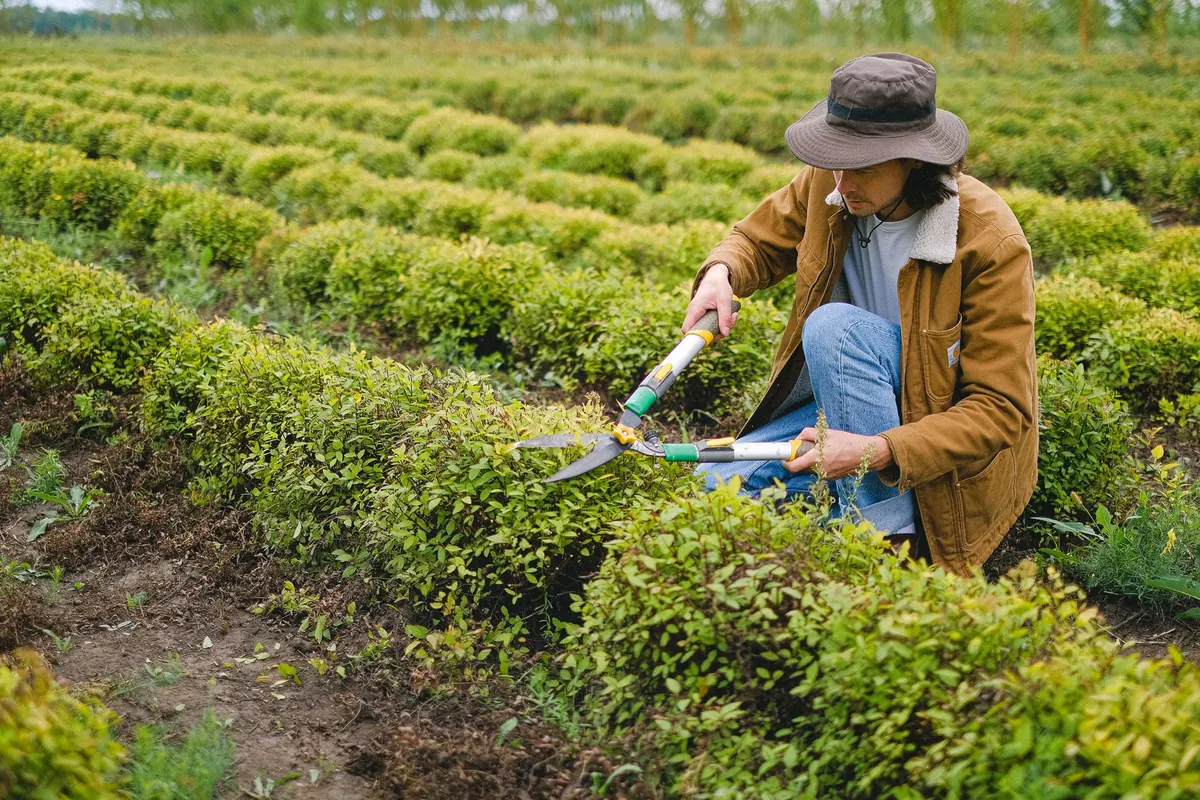
Sharp tools matter more than expensive ones. A blunt blade crushes stems instead of cutting them, leaving a ragged wound that heals slowly. Use bypass secateurs for stems up to about the thickness of your thumb, loppers up to roughly three times that, and a pruning saw for anything thicker. Clean the blades with methylated spirits between plants if you have been cutting diseased material.
Work through the shrub in this order:
- Remove dead, diseased and damaged wood first.
- Take out branches that cross, rub or grow into the centre.
- Thin congested growth right down at the base to let light in.
- Shorten what remains, cutting to a healthy outward-facing bud or a strong side shoot.
- Cut just above the bud at a slight angle, sloping away from it, about a bud's width clear.
- Never leave long stubs. They die back, and the dieback invites disease in.
Aim to end with an open, balanced framework. Step back every few cuts and look at the whole shrub rather than working your way around it in a trance.
When to step back
Put the secateurs down if the wood is frozen, if a hard frost is forecast within a day or two, or if the shrub is one of the old-wood flowerers. Leave berried shrubs such as holly, pyracantha and cotoneaster for the birds until late winter, and resist tidying away every hollow stem and seed head — they are shelter for overwintering insects.
Your winter pruning routine
Start with a walk round the garden and a notebook. Note which shrubs flowered well last year and when. Sharpen and clean your tools indoors first. Then work in a mild spell, beginning with the three Ds across the whole garden before you make any shaping cuts.
Prune the new-wood shrubs hard, the old-wood shrubs not at all, and leave the evergreens until spring. Clear the cuttings, stand back, and let the weather do the rest. By April the difference will be obvious — thicker stems on the dogwoods, a bushier buddleja, and flowers still intact on everything that needed patience.
Photo: Anna Shvets / Pexels